Product Investigation · AI-Assisted Portfolio Project
Netflix Event Pass
A Product Investigation
"Could a one-time live event purchase become Netflix's next customer acquisition channel?"
This project explores a hypothetical product opportunity - from initial research and strategy through prototype, instrumentation, synthetic data analysis, and executive recommendation.
Begin the InvestigationLive events as high-intent acquisition moments
Research -> Prototype -> Instrument -> Analyze
Variant recommendation + product roadmap
How to read this investigation
This project is structured as a product investigation. Each stage shows the decision I made, the artifact I created, and the Product Manager skill demonstrated - from opportunity framing through instrumentation, synthetic data analysis, and roadmap recommendation.
How the product question was framed at each stage
The document, prototype, data map, or analysis created
The PM capability demonstrated at that stage
Opportunity
Live events create moments of high intent, but full subscriptions can feel like too much commitment for viewers who only want access to one premium moment. This investigation explores whether a transactional Event Pass could reduce that friction while creating a path toward membership.
Live events create concentrated bursts of viewer intent, but the current subscription path can feel too heavy for users who only want one premium moment.
A low-friction, one-time Event Pass could convert event-driven demand into a recurring membership path if the post-event offer is timely and clear.
The user may value the event, but not yet value the full catalog. Event Pass tests whether Netflix can meet that narrower intent without weakening the core subscription model.
Can transactional access become a member acquisition engine rather than a one-and-done purchase?
Skill: Identifies ambiguous product opportunities and frames them as testable business questions.
Why this opportunity matters
Live events create concentrated bursts of viewer intent. The strategic question is whether Netflix can convert that moment into durable membership without weakening the core subscription model. Event Pass tests a lower-friction entry point: one premium moment first, then a transparent path into membership.
High-intent moment
The user arrives with a specific event in mind.
Lower-friction entry
A one-time pass reduces the commitment barrier.
Membership bridge
The post-event offer tests whether intent can extend beyond the event.
Research
Before designing anything, I needed to understand the landscape: competitive analogies, user behavior signals, and the structural tension between live-event demand and subscription commitment. Research surfaced the assumptions worth testing.
AI-assisted research helped identify comparable transactional models, event-driven acquisition patterns, and assumptions worth testing.
Live-event demand is high-intent and time-sensitive, making it a useful environment for testing lower-friction acquisition paths.
Transactional access models are familiar to users in sports, concerts, rentals, and pay-per-view experiences, but the strategic risk is subscription dilution.
The research did not prove the product should exist; it clarified which assumptions needed prototype, instrumentation, and funnel validation.
Artifact
Click image to enlarge
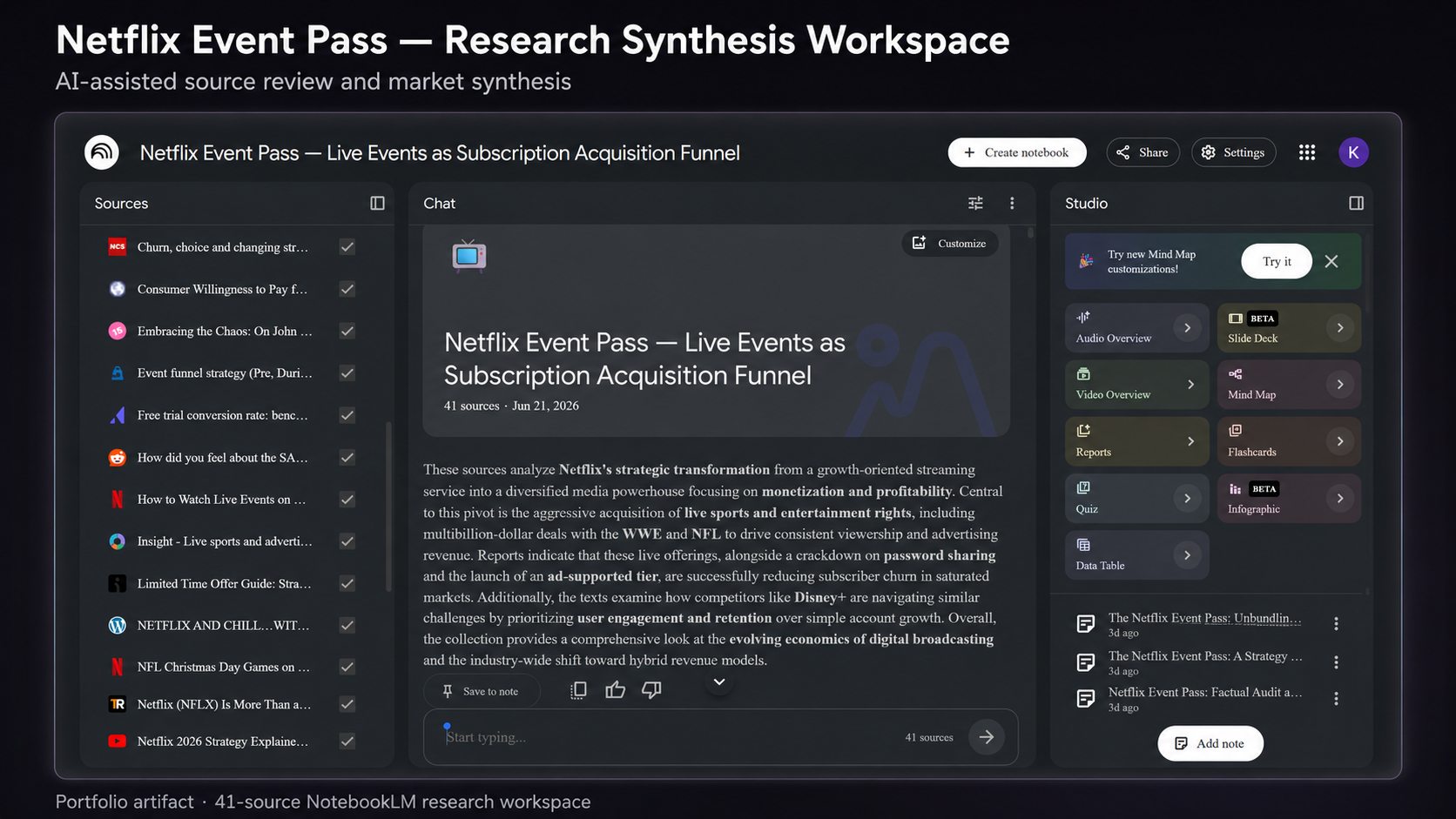
Skill: Synthesizes external research into product implications and testable assumptions.
Product Strategy
Research findings shaped a clear product hypothesis: a time-limited Event Pass, anchored to a premium live event, could serve as a lower-friction acquisition channel. The strategy defined target users, value proposition, offer variants, and explicit risks.
Decision
Defines the problem, target users, product concept, success metrics, risks, and experiment structure.
Open Product Brief ->Primary segments include new non-members, lapsed members, and potential gifters. Existing members are treated as a cannibalization guardrail, not the acquisition target.
For users: access to one high-value live moment without a full subscription commitment. For Netflix: a measurable on-ramp into membership.
Key risks include plan cannibalization, live-event rights complexity, ad-plan margin assumptions, and dark-pattern concerns around conversion prompts.
Skill: Defines user problem, product hypothesis, constraints, and success criteria before designing a solution.
Artifact
Strategy Canvas
Problem
Subscription commitment deters high-intent live event viewers from converting.
Hypothesis
A transactional Event Pass lowers friction and creates a subscription on-ramp.
Users
Event-curious non-members, lapsed members, and potential gifters.
Risks
Plan cannibalization, rights complexity, ad-plan economics, and opt-in clarity.
Experience Design
Translating strategy into experience required mapping the full user journey: from landing page to post-event membership offer. Three user segments and two offer variants shaped distinct journey paths.
Decision
Maps the path from discovery to checkout, live event access, post-event offer, upgrade, and first billing cycle retention.
Variant A tests a clear ad-plan conversion offer. Variant B tests a softer bridge offer. Control uses the standard join path.
The purchase flow is intentionally narrow: event landing, CTA, checkout, payment, confirmation, and access.
The post-event moment is the strategic conversion point: rating, related content, membership offer, upgrade, or decline.
User Journey Flow
Skill: Designs end-to-end experiences across acquisition, activation, conversion, and retention.
Prototype
Prototype screens brought the Event Pass concept to life - from discovery through checkout, live event access, and the post-event membership prompt.
Decision
Frames the event as the hero moment and presents Event Pass as a low-friction access path.
Tests whether the pass can be purchased quickly without overwhelming users with full membership decisions too early.
Validates the core promise: simple access to the premium live moment the user came for.
Introduces the membership offer after the event, when intent and satisfaction signals are freshest.
Skill: Uses prototyping to make abstract product strategy tangible and testable.
Artifact
Click image to enlarge
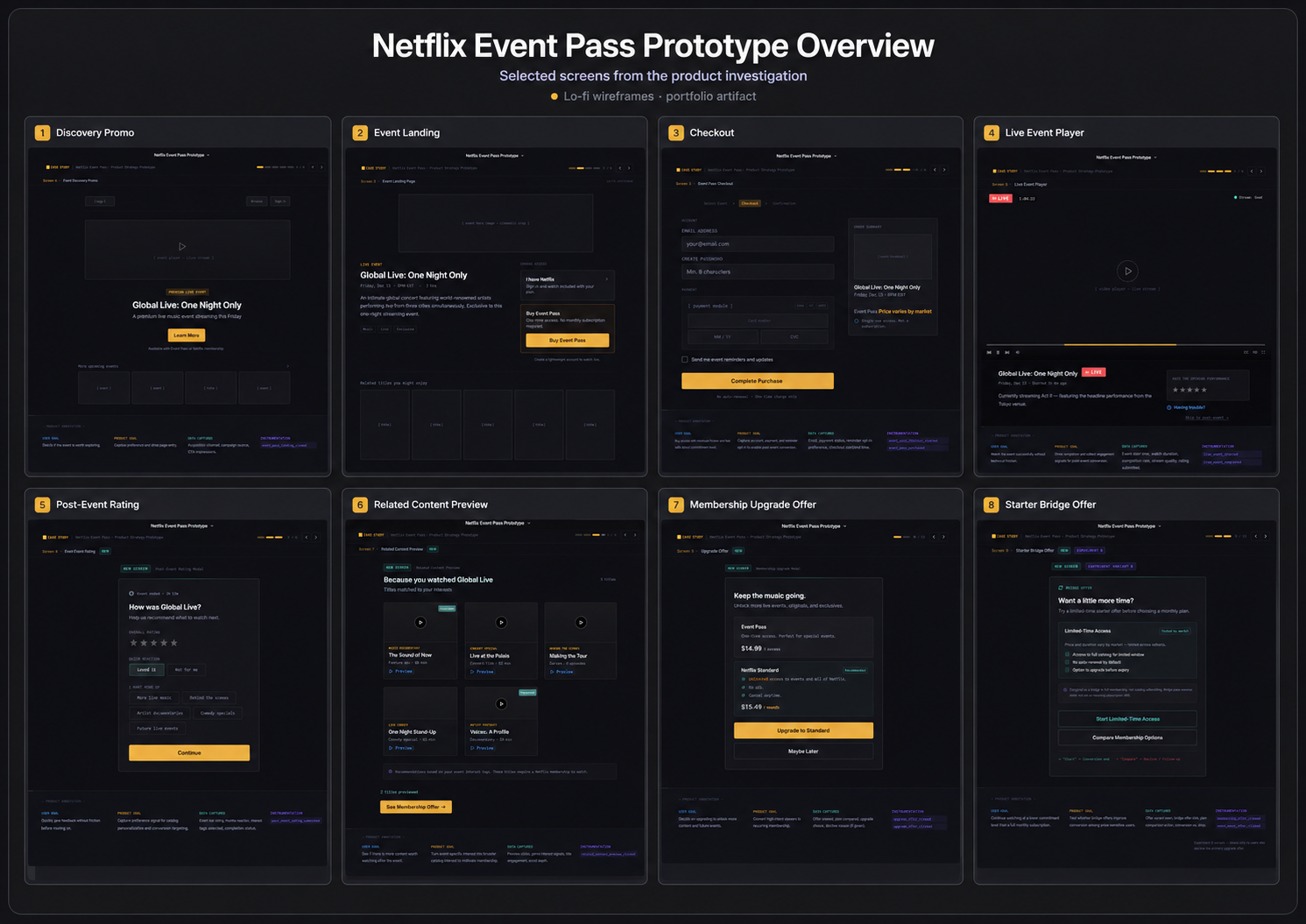
View the full prototype flow in Figma, including the landing, checkout, live event, post-event rating, related content, and upgrade offer screens.
Open Full Figma Flow ->Instrumentation
Every user action generates a signal. The instrumentation plan defines the event taxonomy, funnel steps, and variant properties needed to measure whether the Event Pass hypothesis holds at scale.
Decision
Defines the behavioral events needed to measure the funnel from landing view through first billing cycle retained.
Connects each user journey step to event names, required properties, and analysis destinations.
Uses a 10-step ordered funnel to measure acquisition, event consumption, post-event offer engagement, upgrade, and retention.
Captures offer arm, user segment, source channel, event ID, plan type, and downstream retention state.
Artifact
Click image to enlarge
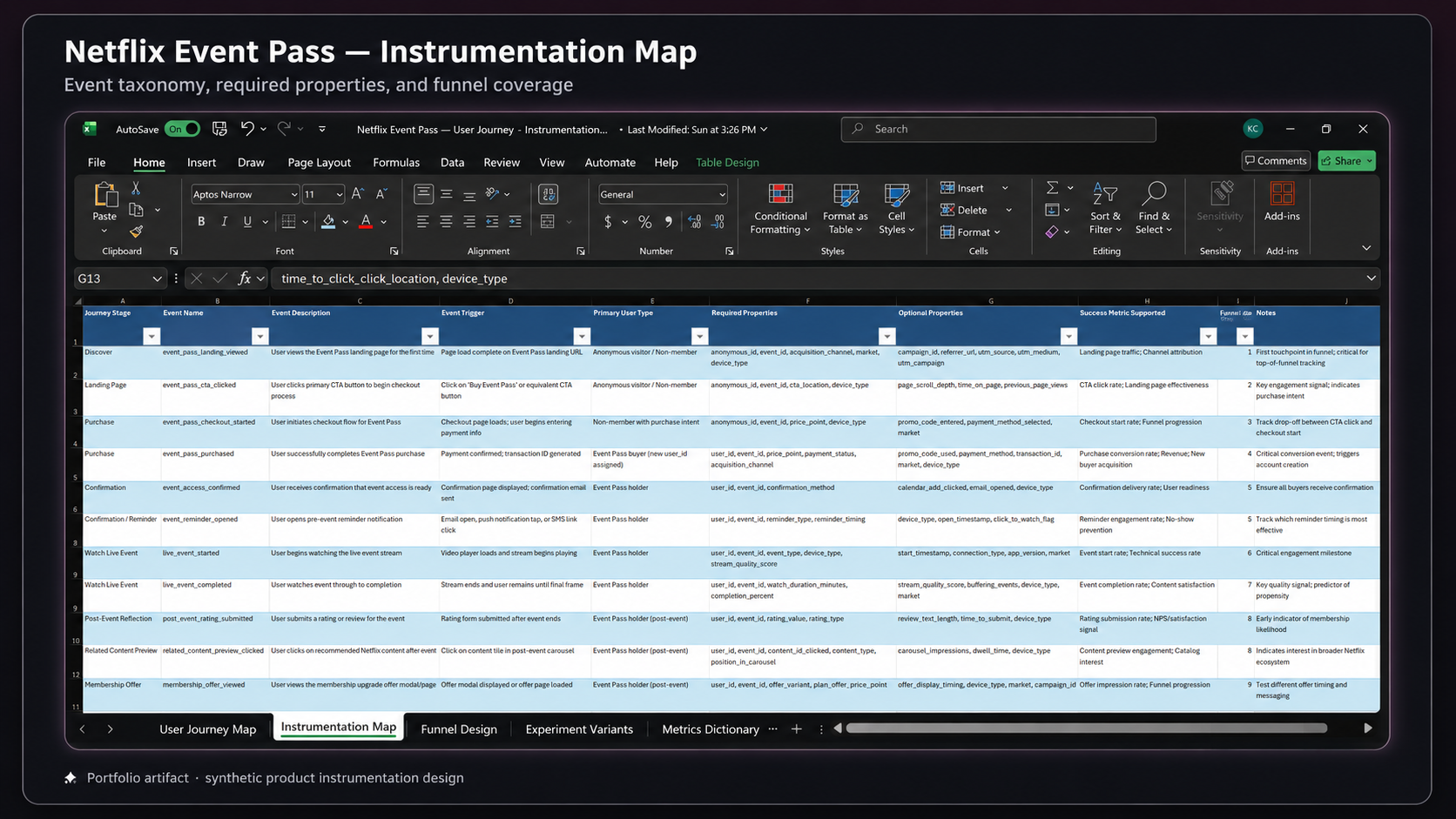
Event Funnel
event_pass_landing_viewedevent_pass_cta_clickedevent_pass_checkout_startedevent_pass_purchasedlive_event_startedlive_event_completedmembership_offer_viewedmembership_offer_clickedmembership_upgrade_completedfirst_billing_cycle_retainedSkill: Connects user behavior to measurable product outcomes through thoughtful event instrumentation design.
Data Build
To pressure-test the instrumentation plan, I constructed a synthetic dataset representing three experiment arms: Ad Plan Offer (Variant A), Bridge Offer (Variant B), and a Control. Events were generated programmatically and ingested via API.
Decision
Built a V2 synthetic dataset with balanced experiment arms and more realistic completion/drop-off behavior than the initial dataset.
Generated structured events that matched the instrumentation taxonomy, including user IDs, event types, timestamps, and offer variant properties.
Sent synthetic event batches into Amplitude to validate whether the proposed taxonomy could support funnel analysis.
Checked event visibility, variant distribution, ordered funnel progression, and obvious realism issues before interpreting results.
Skill: Builds realistic data structures to pressure-test measurement strategy before launch.
JSON Event Snippet
{
  "event_type": "event_pass_purchased",
  "user_id": "usr_8a3f2c",
  "event_properties": {
    "variant": "ad_plan_offer",
    "price": 9.99,
    "event_name": "Live Comedy Special"
  }
}
Ingestion Status
Events visible in Amplitude - Synthetic V2 dataset
Experiment Analysis
With synthetic data ingested, the ordered funnel revealed where users dropped and where Variant A meaningfully outperformed the Control. The analysis drove a clear directional signal for which path to pursue.
Decision
The ordered funnel showed where users moved from landing to purchase, live event completion, post-event offer, upgrade, and retained outcome.
Variant A produced the strongest retained-member outcome in the V2 synthetic simulation.
The weakest step was Membership Offer Viewed -> Membership Offer Clicked, where only 31.9% continued.
Variant A retained 7 of 367 landing users, compared with 3 of 366 for Variant B and 1 of 367 for Control.
All data below is from the V2 synthetic simulation. Not real Netflix data.
All Variants - V2 Synthetic Funnel (n=1,100 landing users)
1,100
Landing
687
CTA Clicked 62.5%
378
Purchased 69.1%
141
Offer Viewed 53.2%
11
Retained
Variant A: Ad Plan Offer
V2 synthetic simulation - Not real data
Recommendation signal
Strongest retained outcome
Variant B: Bridge Offer
V2 synthetic simulation - Not real data
Recommendation signal
Moderate signal, weaker than Variant A
Control: Standard Join
V2 synthetic simulation - Not real data
Recommendation signal
Lowest retained outcome - baseline
Funnel Bottleneck - Next Optimization Focus
Membership Offer Viewed -> Membership Offer Clicked
This is the weakest conversion step across all variants. Improving offer click-through is the highest-leverage next action.
Artifact
Click image to enlarge
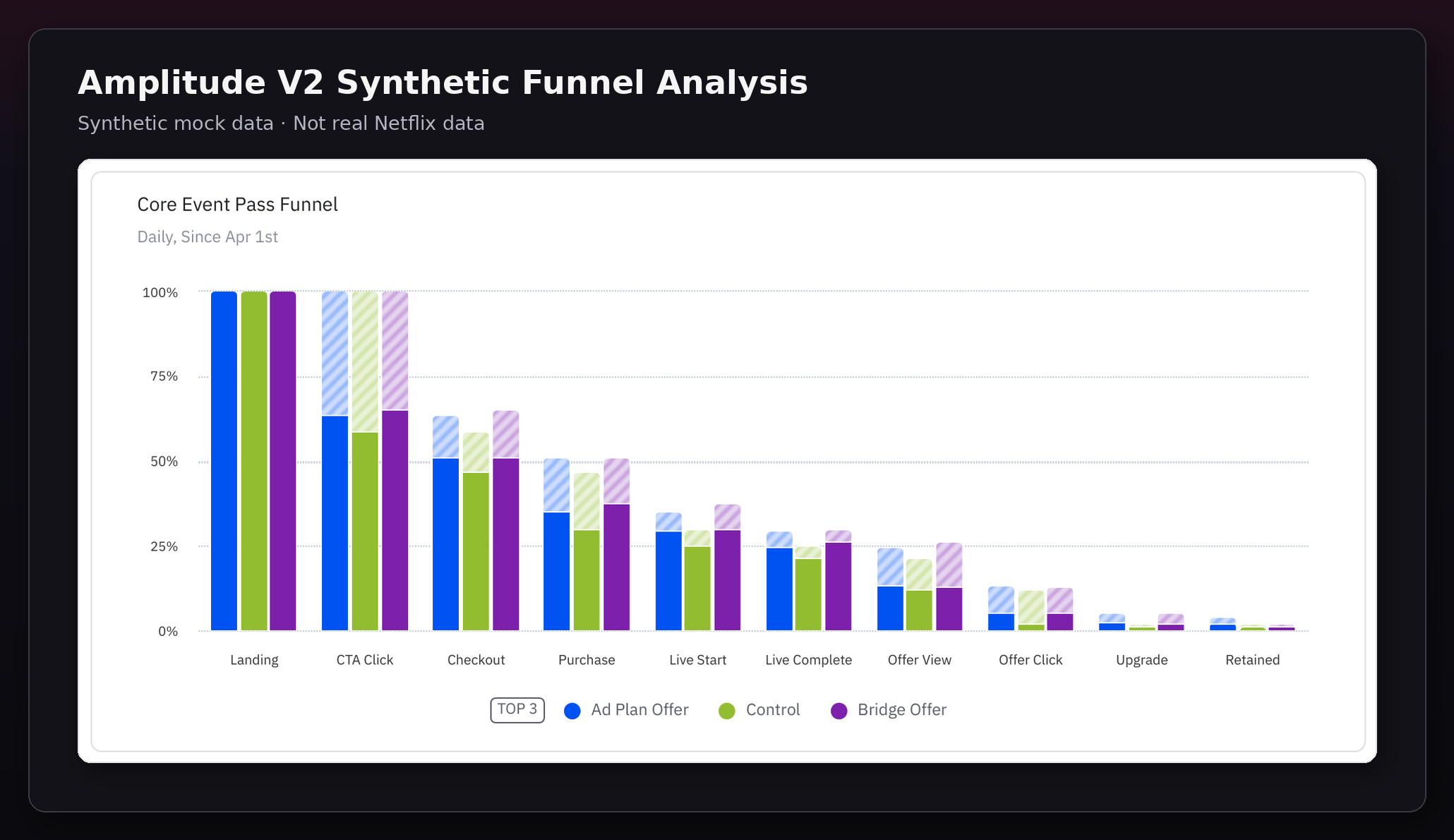
Key Directional Finding
In the V2 synthetic simulation, Variant A produced the strongest retained-member outcome: 7 retained users from 367 landing users (1.91%), compared with 1 retained user from 367 in the Control (0.27%). The next optimization focus is the post-event offer click step: only 31.9% of users who viewed the offer clicked through.
Skill: Uses funnel analysis and experimentation to translate behavioral data into product decisions.
Recommendation
Based on the synthetic experiment analysis, a clear directional recommendation emerged with explicit acknowledgment of what would need validation in a real pilot before scaling.
Decision
Summarizes the opportunity, V2 synthetic findings, recommended variant, key risks, and next experiment path.
Advance Variant A - the Ad Plan Offer - into a controlled real-user pilot, pending usability and opt-in validation.
The biggest product risk is not purchase interest; it is whether the post-event offer feels timely, valuable, and transparent enough to click.
Test offer timing, copy, placement, and opt-in clarity before scaling the concept beyond a controlled pilot.
Skill: Makes product recommendations under uncertainty using evidence, tradeoffs, and clear next steps.
Artifact
Click image to enlarge
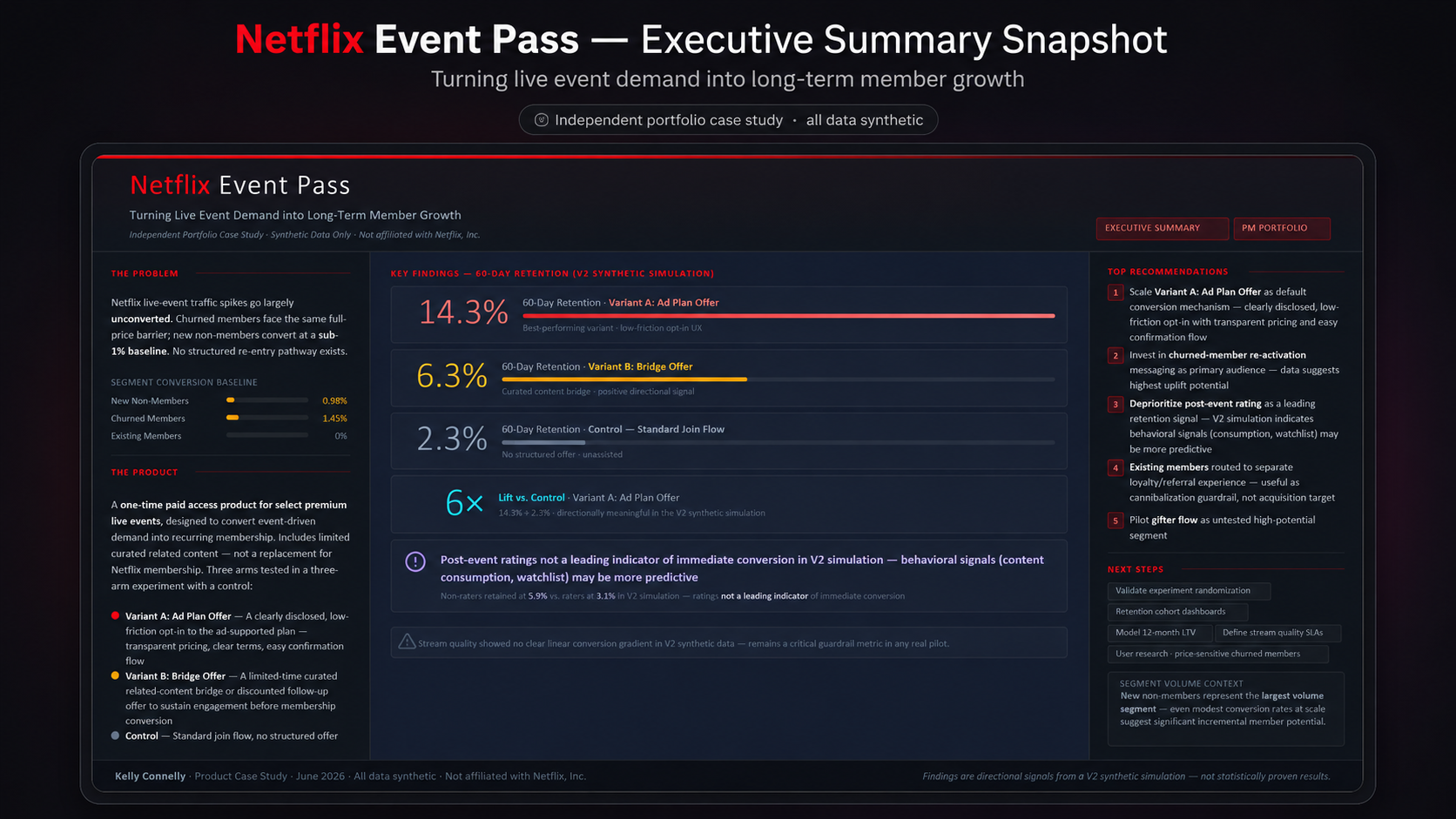
Recommendation
Advance Variant A (Ad Plan Offer) into a real-world controlled pilot.
What I'd Build Next
A first experiment is a starting point, not a destination. The roadmap identifies the next layer of product bets: from offer personalization to fan-intent segmentation to longer-term lifecycle plays.
Decision
Use viewing behavior, related content clicks, and event category to tailor the post-event membership offer.
Separate casual viewers from high-intent fans to understand which groups are most likely to convert after a live event.
Explore whether a limited starter plan could bridge the gap between one-time access and full membership.
Design post-event email and in-app messaging that extends intent beyond the live event window.
Now
- -Improve offer timing and click-through rate on post-event prompt
- -A/B test offer copy and placement
- -Validate stream quality SLA impact on conversion
Next
- -Segment by fan intent and live event type
- -Test gifter flow for Event Pass purchases
- -Personalize post-event recommendations
Later
- -Explore bundled event passes
- -Limited starter plans as conversion step
- -Content follow-on recommendations engine
Skill: Thinks beyond launch into iteration, learning velocity, and growth loops.
Reflection
This project reinforced that strong product work is not just about designing an experience. It is about framing the right question, making assumptions visible, instrumenting behavior, and using evidence to decide what to build next.
Decision
Synthetic data is useful when it forces the product team to define the behaviors, events, and decisions that would matter in a real launch.
Willingness to pay, offer timing, event-type sensitivity, and whether users understand the opt-in membership path.
I would run user interviews earlier, especially with lapsed members and event-only viewers, before refining the offer variants.
Frame the question, make assumptions visible, prototype the experience, instrument the behavior, and use evidence to decide what to build next.
Skill: Demonstrates self-awareness, learning orientation, and product judgment under ambiguity.
Artifact
Complete written investigation: all stages, data, artifacts, and recommendations.
Open Full Case Study →"Strong product work is not just about designing an experience. It is about framing the right question, making assumptions visible, instrumenting behavior, and using evidence to decide what to build next."
- Kelly Connelly