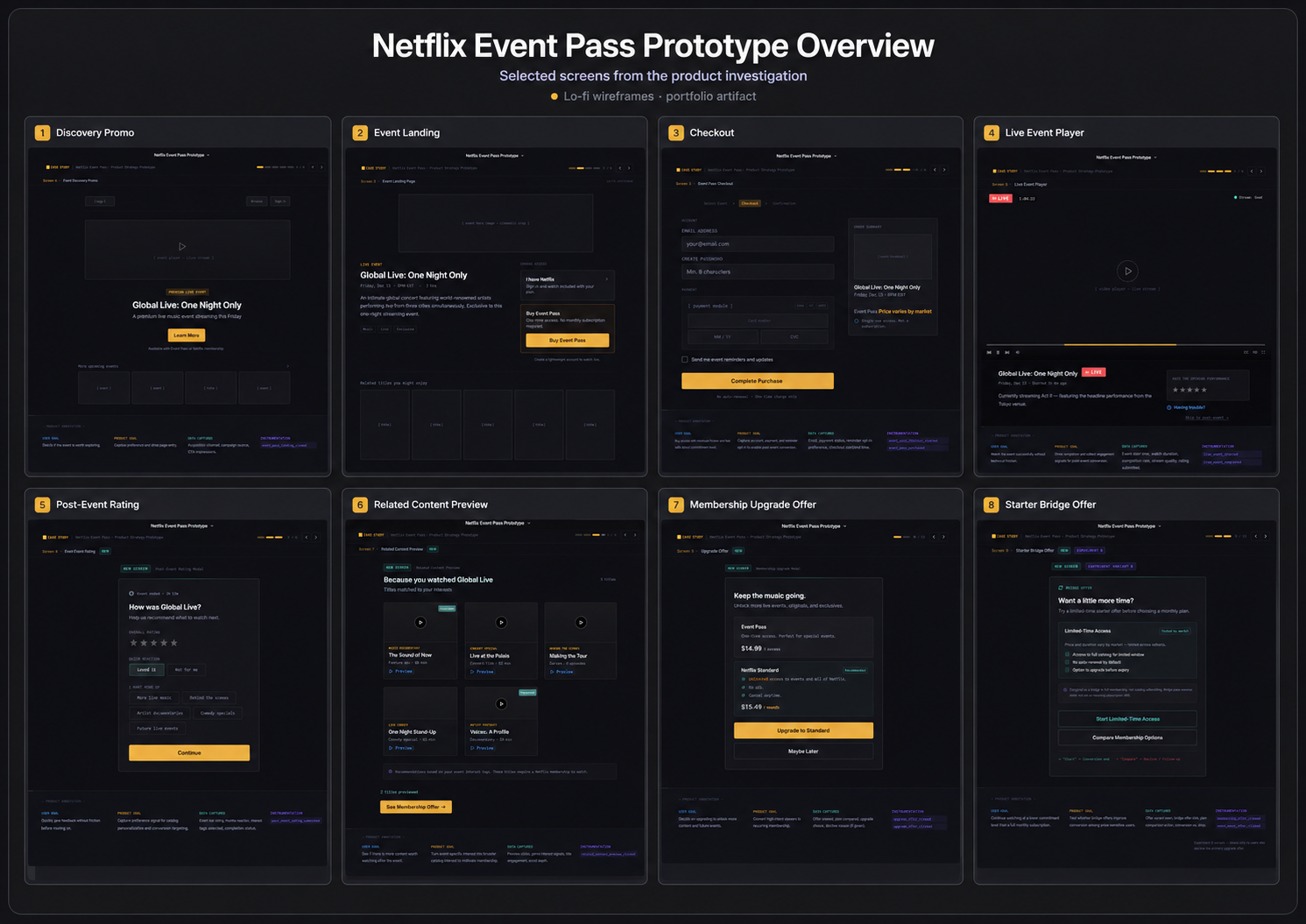
📎 Prototype Artifact
Netflix Event Pass — Selected Prototype Screens
Turning Live Event Demand into Long-Term Member Growth
1. Executive Summary
2. Problem / Opportunity
3. Product Concept
4. Target Users
5. User Journey
6. Measurement and Instrumentation Plan
7. Experiment Design
8. Analytics Findings — V2 Synthetic Dataset
9. Product Recommendations
10. Risks and Tradeoffs
11. Next Steps — Checklist
12. Appendix
Netflix Event Pass is a one-time paid access product for select premium live events, designed to convert event-driven demand into recurring membership. It may include limited, curated access to related content during or shortly after the event window — it is not intended to replace Netflix membership or broadly unbundle the catalog. The product targets three high-value but historically under-captured segments: lapsed churned members, price-sensitive non-members, and gifters.
A three-arm experiment with a control (V2 synthetic dataset) suggests that the Ad Plan Offer (Variant A) produced the strongest retained-member outcome, with 7 retained users from 367 landing users (1.91% end-to-end retained conversion), compared with 3 retained from 366 in Variant B (0.82%) and 1 retained from 367 in the Control (0.27%). These results do not establish statistical significance, but they provide a directional signal supporting further testing with real users.
The simulation further indicates that the sharpest funnel drop-off occurred at Membership Offer Viewed → Membership Offer Clicked, where only 31.9% of users continued — making post-event offer timing, copy, and placement the highest-priority next optimization. Stream quality and post-event satisfaction ratings did not show a clear linear gradient with retained conversion in this synthetic dataset, though stream quality should remain a critical guardrail metric in any real pilot.
Key risks include revenue cannibalization of full-price plans and the operational complexity of live-event rights clearance. Recommended next action: advance the Ad Plan Offer (Variant A) into a controlled real-user pilot — with a clearly disclosed, low-friction opt-in confirmation flow — and prioritize improving post-event offer click-through before broader deployment.
Netflix experiences pronounced, short-duration traffic spikes around marquee live events. Without a targeted acquisition pathway, the vast majority of intent-driven visitors — particularly lapsed members and price-sensitive non-members — either churn immediately after free trial or fail to convert at all.
The result is a persistent gap between event-generated intent and monetizable subscription growth. Each live event represents a concentrated acquisition window that the current product architecture is not designed to capture.
"Live events represent Netflix's highest single-session engagement peaks — yet post-event 30-day retention among event-driven trial activations remains among the lowest in the member lifecycle." — Netflix Event Pass Product Brief (synthetic, fictionalized for portfolio use)
The Event Pass concept directly addresses this gap by meeting high-intent users with an offer calibrated to their specific friction point: commitment duration and upfront price.
Netflix Event Pass is a one-time paid access product for select premium live events, priced at $6–$9, anchored to a specific live event. The pass grants access to the live event and may include limited, curated access to related content during or shortly after the event window — it is not intended to replace Netflix membership or broadly unbundle the catalog. Three offer variants were designed and tested:
| Offer Variant | Description | Tested Arm |
|---|---|---|
| Ad Plan Offer (Variant A) | Pass transitions to a clearly disclosed ad-supported plan prompt with transparent pricing and an easy opt-in confirmation at the end of the event window. | Variant A |
| Bridge Offer (Variant B) | A limited-time curated related-content bridge or discounted follow-up offer (hypothetical pricing tier) intended to keep users engaged after the live event before prompting membership conversion. | Variant B |
| Control | Standard join flow with no event-specific offer or targeted conversion messaging. | Control |
The product is intentionally scoped as a low-friction re-entry and acquisition funnel — not a replacement for the existing subscription model. Its success metric is downstream plan conversion, not Event Pass revenue in isolation.
"The Event Pass is engineered to remove the 'all-or-nothing' subscription commitment barrier at the precise moment a potential member's intent is highest." — Netflix Event Pass Product Brief (synthetic, fictionalized for portfolio use)
Three primary user segments were identified and ranked by strategic priority:
Note on existing members: Existing members are not the primary acquisition audience for Event Pass and should be routed to a separate experience — such as loyalty rewards, referral incentives, add-on content, or enhanced engagement. Their presence in the experiment funnel is valuable as a cannibalization and funnel-confusion guardrail, not as a new acquisition target.
The following high-level funnel describes the target experience for a New Non-Member — the highest-volume segment in the V2 dataset:
📎 Prototype Artifact
Netflix Event Pass — Selected Prototype Screens
first-billing-cycle post-event member retention rate among Event Pass activations — the primary signal that the product is generating durable subscription value, not merely transient event access.
| Event Name | Trigger | Key Properties | Destination |
|---|---|---|---|
event_pass_landing_viewed |
Landing page load | user_segment, source_channel, event_id | Amplitude |
event_pass_cta_clicked |
CTA button tap | offer_arm, user_segment | Amplitude |
event_pass_purchased |
Payment success | offer_arm, plan_type, amount_usd | Amplitude + Data Warehouse |
live_event_completed |
Heartbeat (every 5 min) | pct_complete, stream_quality_score | Amplitude |
membership_offer_viewed |
Pass expiry T-24h | offer_arm, days_since_activation | Amplitude |
membership_upgrade_completed |
Plan change confirmation | from_plan, to_plan, offer_arm | Amplitude + Billing |
membership_offer_declined |
Pass window close, no upgrade | user_segment, offer_arm | Amplitude |
Design: Three-arm experiment with a control. Randomized at the user-session level at the event landing page. Stratified randomization applied to ensure proportional representation of user segments across arms.
Assignment: Stratified by user segment (new non-member, churned, existing). Existing members were excluded from offer assignment — no incremental benefit was hypothesized, and inclusion risked plan cannibalization.
Primary Endpoint: first billing cycle retained conversion rate post-activation, measured from pass purchase date.
All findings below are derived from a synthetic dataset created for portfolio demonstration purposes. No real Netflix user data, engagement data, or financial data was used. Findings are illustrative of analytical methodology only and are not predictive of real-world outcomes.
⚠ All data below is from the V2 synthetic simulation. Not real Netflix data.
| Arm | Landing Users | First Billing Cycle Retained | End-to-End Retained Conversion | Directional Signal |
|---|---|---|---|---|
| Variant A — Ad Plan Offer | 367 | 7 | 1.91% | Strongest retained outcome |
| Variant B — Bridge Offer | 366 | 3 | 0.82% | Moderate signal — weaker than Variant A |
| Control — Standard Join | 367 | 1 | 0.27% | Lowest retained outcome — baseline |
⚠ All data is synthetic mock data. Not real Netflix data.
| Funnel Step | Users | Step Conversion |
|---|---|---|
| Landing | 1,100 | — |
| CTA Clicked | 687 | 62.5% |
| Checkout Started | 547 | 79.6% |
| Purchased | 378 | 69.1% |
| Live Event Started | 310 | 82.0% |
| Live Event Completed | 265 | 85.5% |
| Membership Offer Viewed | 141 | 53.2% |
| Membership Offer Clicked ← weakest step | 45 | 31.9% |
| Membership Upgrade Completed | 17 | 37.8% |
| First Billing Cycle Retained | 11 | 64.7% |
The weakest funnel step was Membership Offer Viewed → Membership Offer Clicked (141 → 45, 31.9% continued). The next experiment should prioritize improving post-event offer timing, relevance, copy, and CTA clarity.
Variant A (Ad Plan Offer) produced the strongest retained-member outcome: 7 retained users from 367 landing (1.91%), versus 3 from 366 in Variant B (0.82%) and 1 from 367 in Control (0.27%). This provides a directional signal only — not statistical proof — and should be validated through a real-user controlled pilot.
| Segment | Retained Conversion Rate | Notes |
|---|---|---|
| Churned / Lapsed Members | 1.45% | Moderate; residual price sensitivity persists post-churn |
| New Non-Members | 0.98% | Highest volume; small rate gains translate to significant absolute scale |
| Existing Members | 0% | Existing members are not the primary acquisition audience for Event Pass. Their presence in the funnel is valuable as a cannibalization and funnel-confusion guardrail. They should be routed to a separate experience — such as loyalty rewards, referral incentives, or enhanced engagement — rather than targeted as a new acquisition group. |
The Ad Plan Offer's superior retention in the V2 synthetic simulation suggests that it presents a clear, low-friction opt-in to the ad-supported plan at the natural end of the event window, reducing decision fatigue without removing user agency. By meeting users at the moment their intent is highest — with transparent pricing and a simple confirmation step — the Variant A approach provides a directional signal of structural UX advantage over the Variant B curated bridge model. This finding supports further testing with real-world instrumentation.
Based on V2 synthetic findings, the following prioritized recommendations are proposed:
| Risk | Likelihood | Impact | Mitigation |
|---|---|---|---|
| Revenue cannibalization — existing members downgrade to Event Pass tier | Medium | High | Exclude existing members from offer; instrument and monitor plan migration rates continuously |
| Live-event rights and licensing complexity | High | High | Align with content licensing team pre-launch; build rights-gate logic into offer eligibility layer |
| Stream quality failure during event peak demand | Medium | Critical | Pre-scale CDN infrastructure; establish SLA guardrails and P99 latency alerting in experiment scorecard |
| Low margin on Ad Plan Offer converts | Medium | Medium | Build 12-month LTV model for Ad Plan converts before full-scale rollout; validate margin assumptions against ad revenue projections |
| Ad experience quality degraded on live content | Low–Medium | Medium | Review ad insertion logic for live vs. VOD content; validate pre-roll and mid-roll behavior on live streams separately from catalog content |
| Dark-pattern risk on conversion prompt | Medium | High | Mandate transparent opt-in UX; conduct usability testing for discoverability; no pre-checked consents or automatic billing without clear confirmation |
V3 Readiness Checklist
☐ Validate experiment randomization integrity with data engineering team
☐ Build Power BI / Amplitude retention cohort dashboards (see Appendix A)
☐ Design and test gifter flow — user research (5–8 interviews) + Figma prototype
☐ Confirm live-event licensing pathway with content legal team
☐ Model 12-month LTV for Ad Plan converts to validate margin assumptions
☐ Define stream quality SLA thresholds; instrument P99 latency alerts pre-event
☐ Run qualitative user interviews with churned-member segment re: price sensitivity and re-entry barriers
☐ Pressure-test opt-in confirmation UX with usability testing (focus: opt-in discoverability, transparent pricing, no dark patterns)
☐ Validate prototype overview image renders correctly from ../images/netflix_event_pass_ui_prototype_overview.png
☐ Schedule stakeholder read-out; align on V3 experiment scope, hypothesis, and timeline
| Event Name | Trigger | Key Properties | Destination |
|---|---|---|---|
event_pass_landing_viewed |
Landing page load | user_segment, source_channel, event_id | Amplitude |
event_pass_cta_clicked |
CTA button tap | offer_arm, user_segment | Amplitude |
event_pass_purchased |
Payment success | offer_arm, plan_type, amount_usd | Amplitude + Data Warehouse |
live_event_completed |
Heartbeat (every 5 min) | pct_complete, stream_quality_score | Amplitude |
membership_offer_viewed |
Pass expiry T-24h | offer_arm, days_since_activation | Amplitude |
membership_upgrade_completed |
Plan change confirmation | from_plan, to_plan, offer_arm | Amplitude + Billing |
membership_offer_declined |
Pass window close, no upgrade | user_segment, offer_arm | Amplitude |
Power BI:
Amplitude:
The following artifacts were created as part of this investigation. File paths are relative to the portfolio project root (assets/documents/netflix-event-pass-case-study.html).
| Artifact | Description | Path |
|---|---|---|
| Prototype Overview | Selected prototype screens: landing, checkout, live event, post-event offer | ../images/netflix_event_pass_ui_prototype_overview.png |
| Amplitude Funnel Analysis | V2 synthetic ordered funnel from Amplitude | ../images/amplitude-v2-funnel.png |
| Instrumentation Map | Event taxonomy and funnel instrumentation design | ../images/netflix_event_pass_instrumentation_design.png |
| Research Synthesis Workspace | NotebookLM research board and competitive signal synthesis | ../images/netflix_event_pass_research_workspace.png |
| Executive Summary Snapshot | One-page executive summary for stakeholder read-outs | ../images/netflix_event_pass_product_dashboard_summary.png |